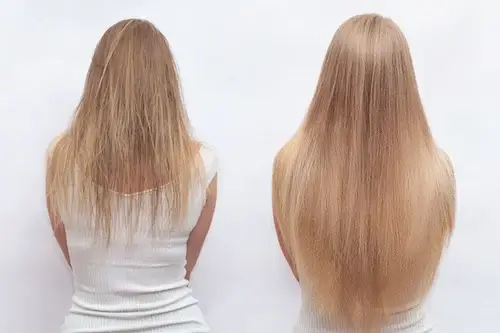
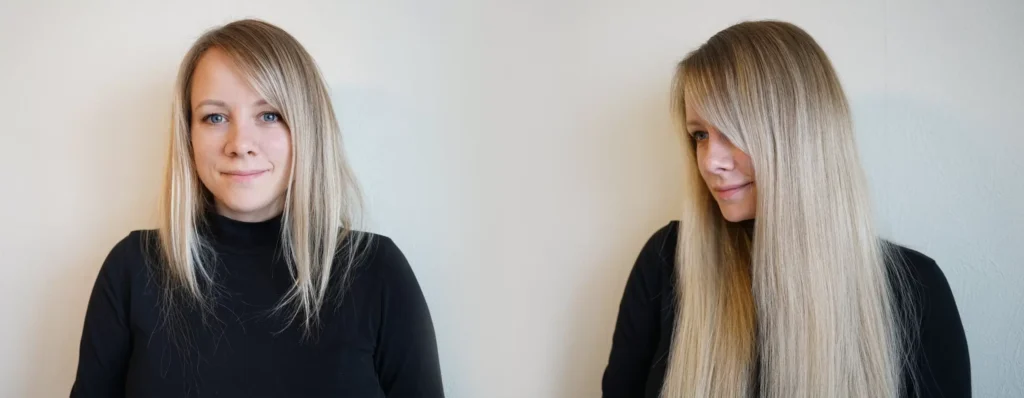
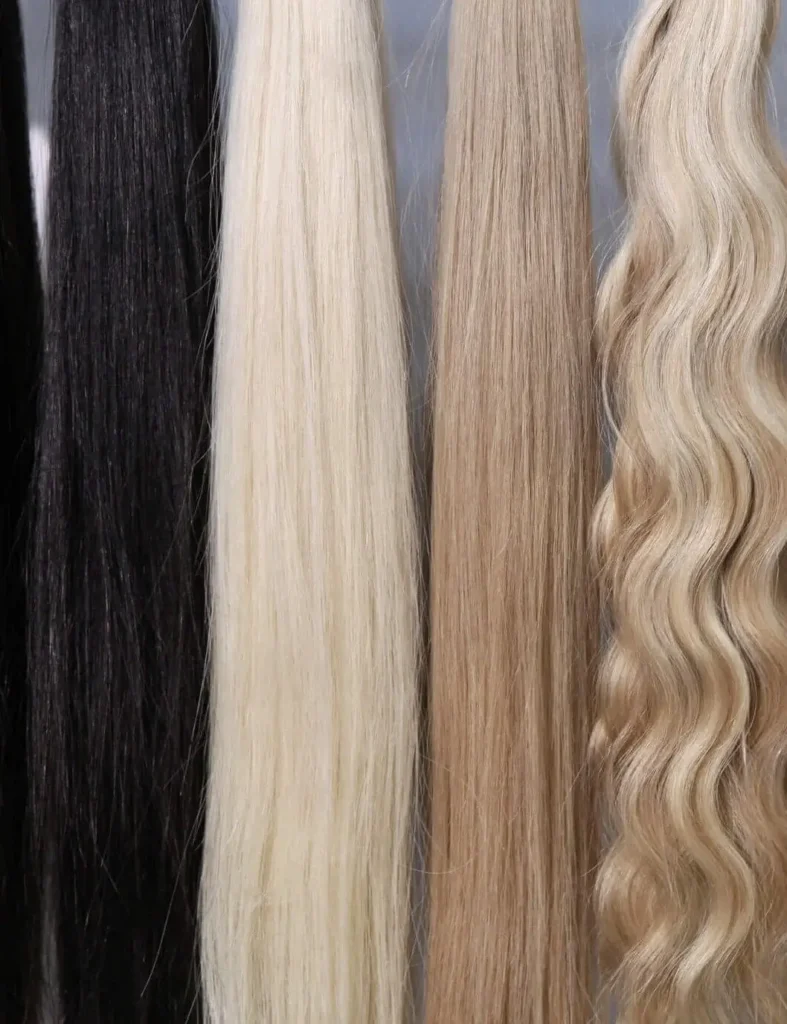
Slavic hair comes from donors in Eastern Europe (primarily Russia, Ukraine, and neighboring countries) and is widely regarded as the highest quality human hair available for extensions. It is prized for its naturally fine texture, intact cuticle alignment, and ability to blend seamlessly with European hair types. For clients who want extensions that look and move like their own hair, Slavic hair is the benchmark everything else is measured against.
Where Does Slavic Hair Come From?
Slavic hair is sourced from donors in Eastern European countries, most commonly Russia, Ukraine, Belarus, and Poland. These regions produce hair with a characteristically fine strand diameter, natural luster, and a straight-to-wavy texture that closely mirrors the natural hair of most Western European and North American clients.
Because the donor population tends to have hair that hasn’t been chemically processed or heat-damaged over years of styling, Slavic hair arrives in its most intact state. The cuticle, the outermost protective layer of each strand, is preserved and aligned in a single direction. That alignment is what makes Slavic hair feel soft, resist tangling, and hold color so well.
True Slavic hair is ethically sourced directly from donors, not collected from temple floors or factory-processed like much of the Indian Remy hair that enters the mass market. The supply is more limited, which is a direct reason for its higher price point and its superior quality.
How Slavic Hair Is Different from Other Extension Types
Not all human hair extensions are the same. Here’s how Slavic hair compares to the most common alternatives:
Indian Remy Hair is the most widely used extension hair globally. It’s collected from temple donations in India, where it’s considered a religious offering. The hair is sorted, treated, and sold as Remy, meaning the cuticles are still intact, but the texture is typically coarser and darker than European hair, making it harder to blend for lighter or finer hair types without significant chemical processing.
Chinese and Vietnamese Hair is often heavily processed with silicone coatings to give it a smooth, shiny appearance. Once those coatings wash out after a few weeks, the hair can become dry, frizzy, and prone to matting. This category makes up much of the budget extension market.
Synthetic Hair is made from plastic fibers. It cannot be heat-styled, dyed, or treated like natural hair. It looks artificial in most lighting and has a much shorter lifespan than any human hair option.
Slavic Hair stands apart because its natural properties (fine strand diameter, cuticle integrity, and light base color) require far less processing to achieve a natural result. It blends with fine to medium European hair textures without looking bulky or mismatched. It accepts color more evenly. It lasts longer, often 12 to 18 months with proper care, and maintains its quality through multiple reinstalls.
Why Hair Studio Seven Sources Slavic Hair
Erin Cooper has been doing hair for over 22 years, and her decision to work exclusively with Slavic hair isn’t a branding choice. It’s a technical one.
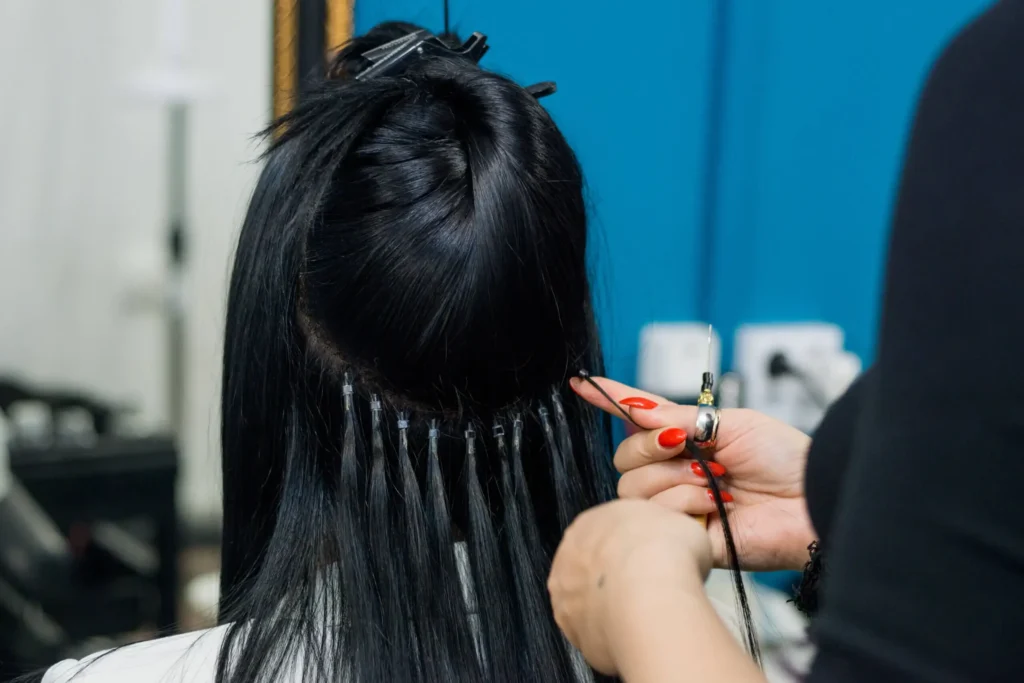
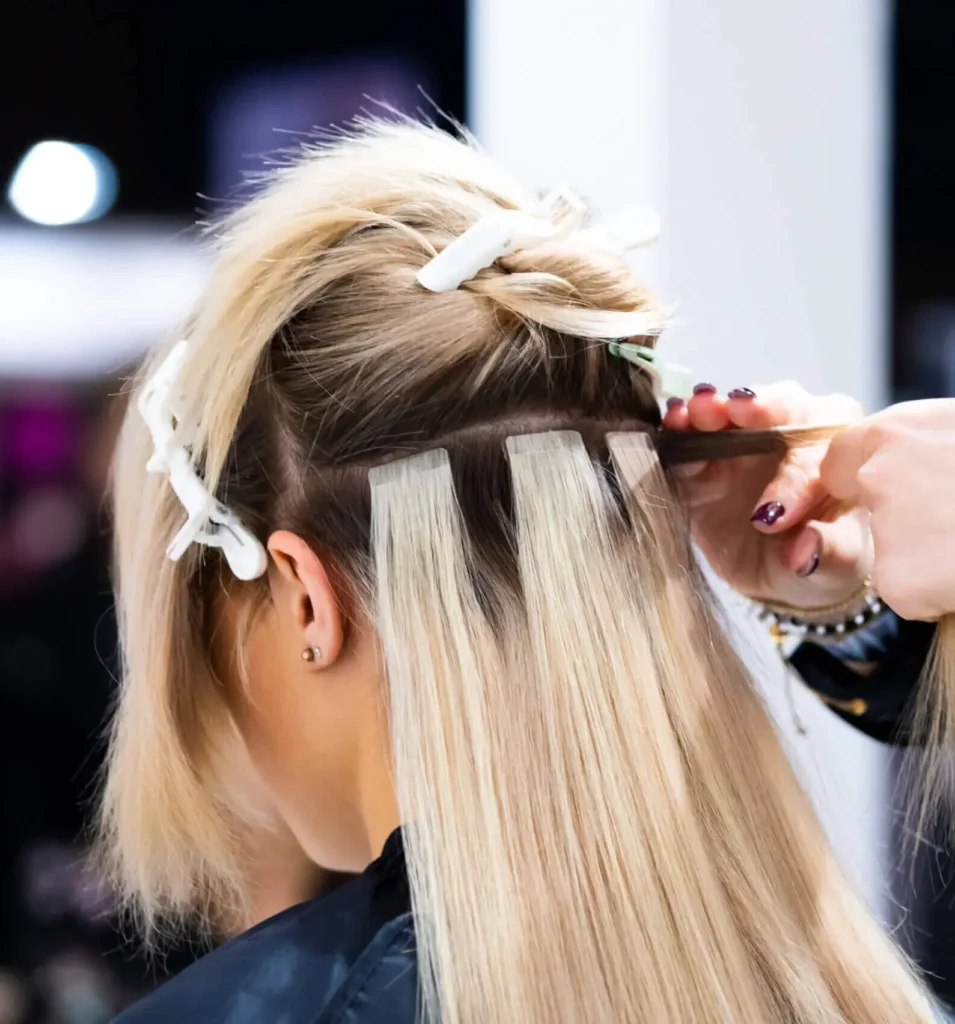
When you’re placing K-Tip, I-Tip, or beaded weft extensions on a client with fine, naturally blonde hair, the margin for error is narrow. The extension hair has to match in texture, movement, and how it takes color. Slavic hair, because of its naturally fine strand diameter and light base, is the only hair that meets that standard consistently.
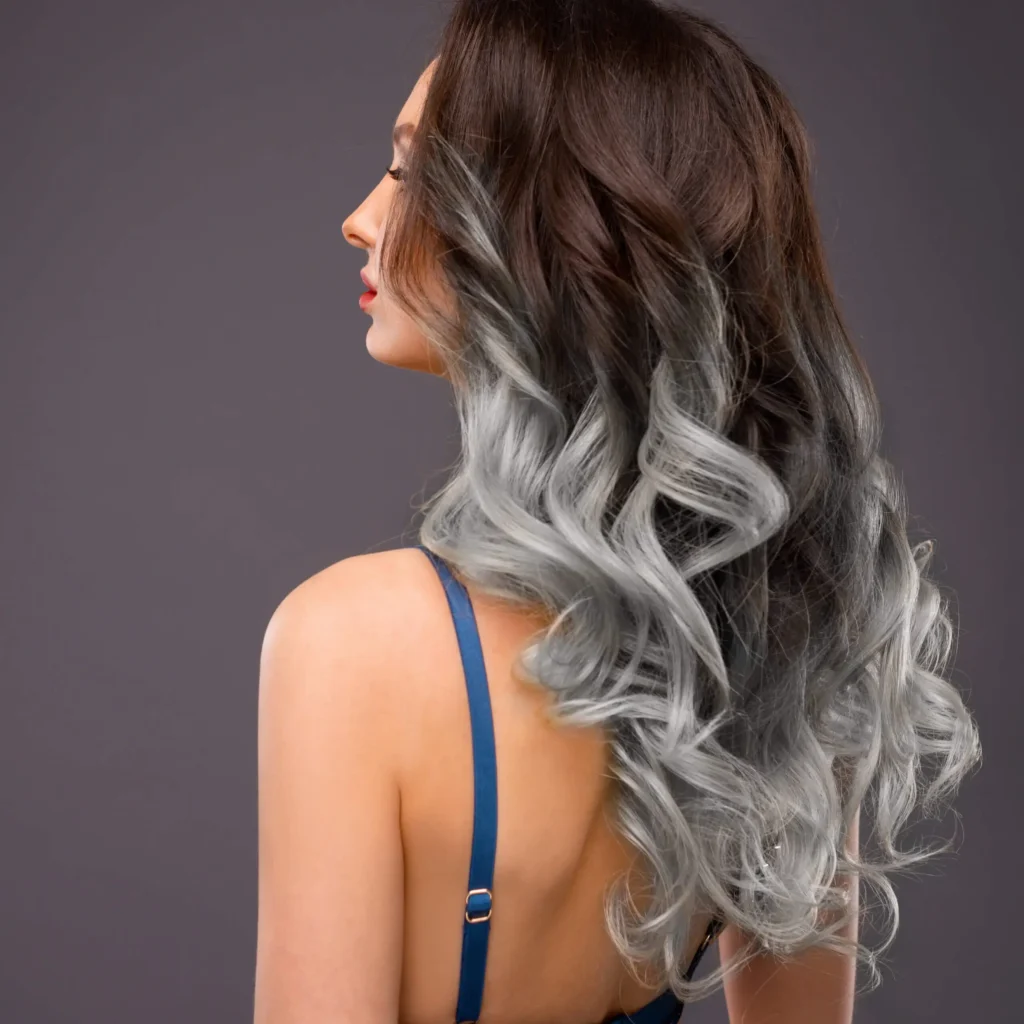
It also means Erin can do custom color blending directly on the extension hair when needed (balayage, toning, color melting) without the hair responding unpredictably or breaking down the way over-processed hair does.
For clients investing in a full set of extensions, this matters. The result looks natural because the hair is compatible with your own, not just close enough.
Is Slavic Hair Worth the Price?
A full set of Slavic hair extensions at Hair Studio Seven can, in some cases, cost as much as $2,000 or more. For clients accustomed to seeing extensions advertised for $300–$800, that number can feel like a large gap. Here’s the honest context:
Lower-cost extension sets typically use Indian Remy, synthetic blended, or processed Chinese hair. Many clients find these options look great on the day of install and begin to degrade within a few months. The hair gets dry, the cuticles start to lift and tangle, and a reinstall requires new hair because the quality hasn’t held.
Slavic hair, maintained properly, can be reinstalled two to three times before replacement is needed. The hair itself doesn’t need to be repurchased every cycle. Over a two-year period, a Slavic hair set often costs less in total than repeatedly replacing a lower-quality set, while consistently looking better.
There’s also the less quantifiable factor: confidence. Clients who’ve done both consistently say Slavic extensions are the first time their hair felt like their hair.
Ready to see Slavic hair samples in person and find out if extensions are right for you? [Book a consultation with Erin →]
Frequently Asked Questions About Slavic Hair Extensions
Is Slavic hair the best for extensions? Slavic hair is widely considered the highest quality human hair for extensions, particularly for clients with fine to medium European hair textures. Its natural cuticle alignment, fine strand diameter, and light base color make it the best option for seamless blending and long-term durability.
How long does Slavic hair last? With proper care and regular maintenance appointments, Slavic hair extensions typically last 12 to 18 months. The hair itself can be reinstalled two to three times before replacement is needed, making it more cost-effective over time than lower-quality alternatives.
Where does Slavic hair come from? Slavic hair is sourced from donors in Eastern Europe, most commonly Russia, Ukraine, Belarus, and Poland. It is ethically sourced directly from donors and is valued for its naturally fine texture, light color, and intact cuticle structure.
What is the difference between Slavic hair and Russian hair? Russian hair is a subset of Slavic hair. All Russian hair is Slavic, but not all Slavic hair is Russian. “Slavic hair” refers broadly to hair sourced from Eastern European donors, while “Russian hair” specifically refers to donors from Russia. Both share similar quality characteristics and the terms are sometimes used interchangeably in the extension industry, though true Russian hair from specific regions is considered among the finest available.